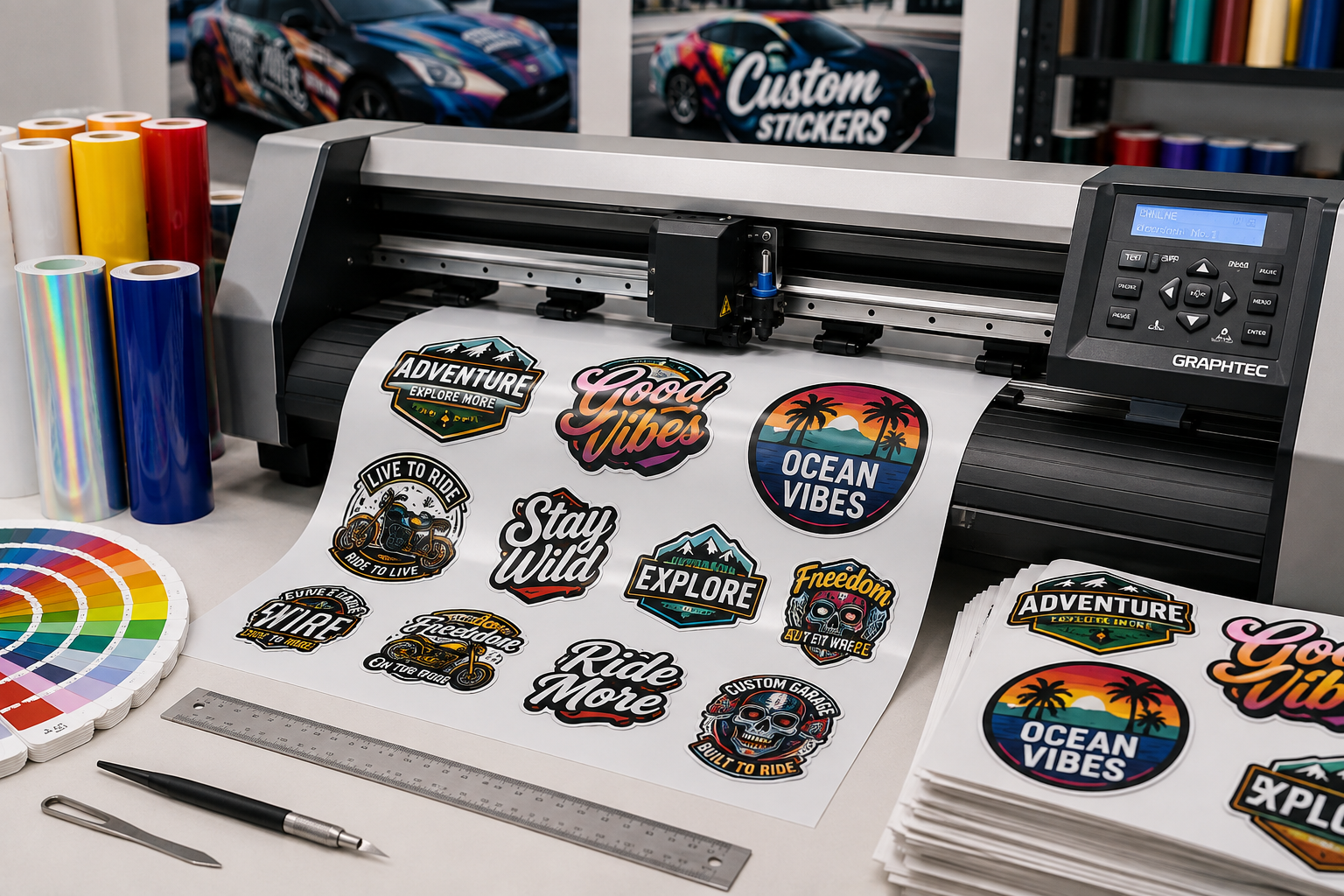
Focus: Choosing the best printer for stickers and vinyl decals in Australia.
Key Considerations: Print quality, media compatibility, running costs, and production volume.
Selection Principle: Choose a printer based on your application, workflow, and long term business needs, not just purchase price.
Professional Insight: Businesses looking for a reliable printer for stickers achieve better results by considering the complete print workflow rather than the printer alone.
Business Outcome: Consistent output, efficient production, and dependable long term performance.
Buying a printer for stickers and vinyl decals is more than a matter of print quality or price. The wrong machine can slow down your production, increase your running costs and limit the kind of work your business can confidently take on.
- Choosing the wrong print technology can result in unnecessary material waste.
- Often the long term impact of running costs is bigger than the initial purchase price.
- Your printer should align to your workload, media requirements and future business objectives.
Bi-Wize has over five decades of experience in assisting Australia’s sign and print industry source equipment to suit production requirements and long term growth. If you’re a business searching for the best sticker printer in Australia, this guide covers what you need to think about before investing, the comparison of the different printer technologies, and the best option for your production needs.
Print Technology Determines What Your Business Can Confidently Take On
Sticker and vinyl production is not a single workflow. Fleet graphics, retail point-of-sale, short-run labels, promotional decals, and architectural vinyl all sit in the same category on paper, but they place very different demands on a machine.
Choosing technology without mapping those demands first is where most equipment decisions go wrong.
The Key Technologies Worth Understanding
1. Eco Solvent
The established choice for outdoor applications. Vehicle graphics, exterior decals, and signage exposed to UV and weather perform well on eco solvent output. Media compatibility is broad, and durability without lamination is a practical advantage for high-volume outdoor work.
2. Latex
Suits indoor retail and display environments where odour and fast turnaround both matter. Output is dry on exit, which removes the wait time that slows finishing workflows. It also suits workplaces where ventilation is limited.
3. UV
Prints directly onto rigid and flexible substrates without requiring a coating step. For businesses running promotional products, specialty materials, or direct-to-substrate work alongside standard vinyl, UV opens up job types that other technologies cannot accommodate.
4. Resin
Delivers strong colour consistency for indoor graphics and performs well in low-odour production environments. Where colour accuracy across repeat runs is critical, resin holds that consistency reliably.
A vinyl decal printer selected around your most frequent job type will outperform a higher-specification machine chosen for occasional work.
What to Assess Before the Technology Decision
Four operational factors need to be defined at this stage:
- Maximum print width across current and foreseeable job types
- Indoor or outdoor application environment for finished output
- Substrate range the business regularly works with
- Available workspace and ventilation requirements for the shortlisted technology
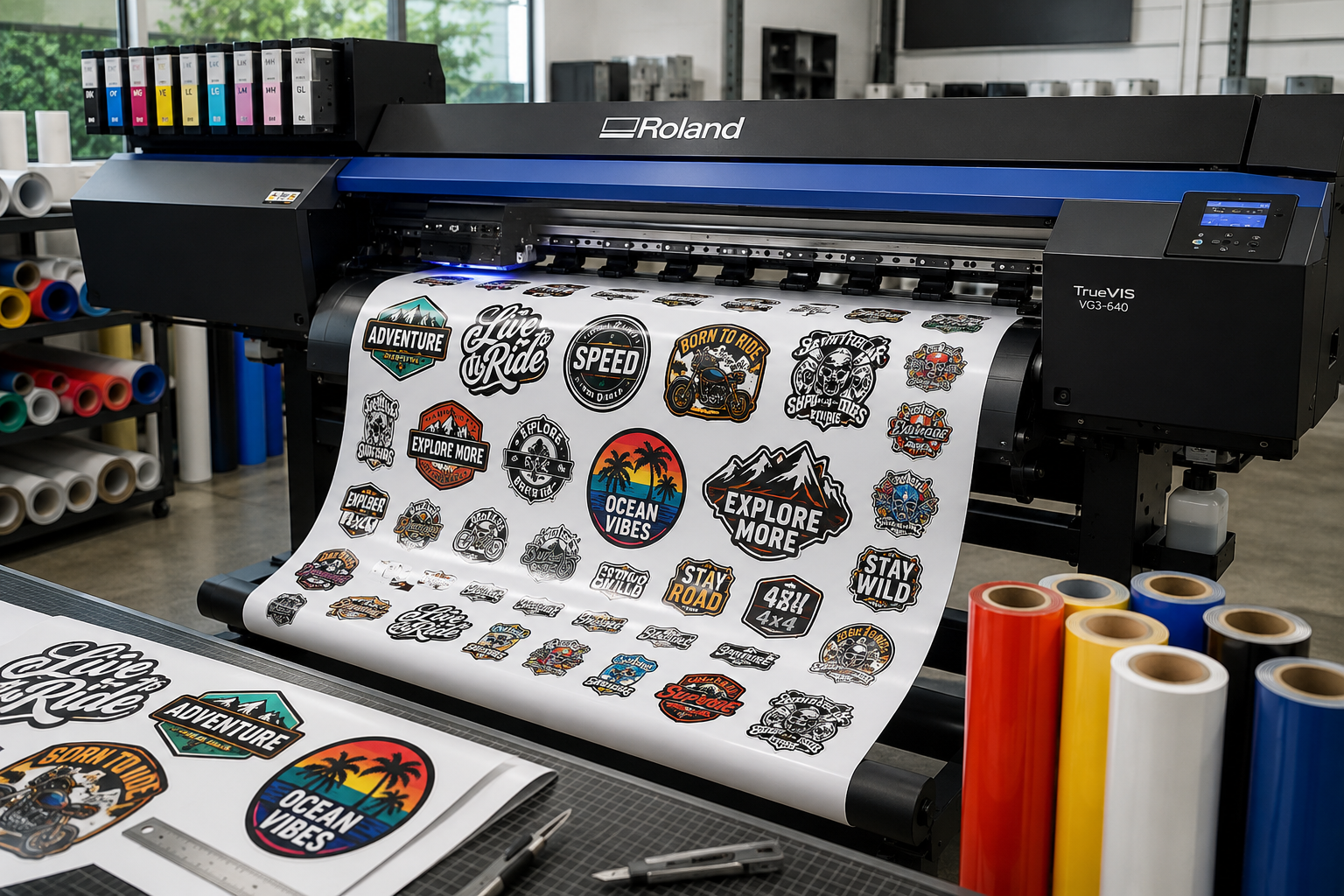
Finishing equipment is the variable most buyers fail to account for entirely. A wide format sticker printer sits at one stage of a multi-step process. Lamination, contour cutting, trimming, and application each affect turnaround times and labour costs downstream. Purchasing a printer without mapping the complete workflow creates bottlenecks that output speed alone cannot resolve.
Roland, Mimaki, Epson, and HP: Matching the Brand to the Business
Brand comparison in the sign industry tends to centre on headline print speed. That focus misses the variables that drive long-term productivity more consistently.
Local technical support response times, spare parts availability through Australian distributors, operator interface familiarity, and workflow integration all generate more measurable day-to-day impact than the speed figures on a specification sheet. A machine that prints faster but sits idle waiting for a service call costs more in real terms than a slower machine with strong local support.
Where Each Brand Performs Best
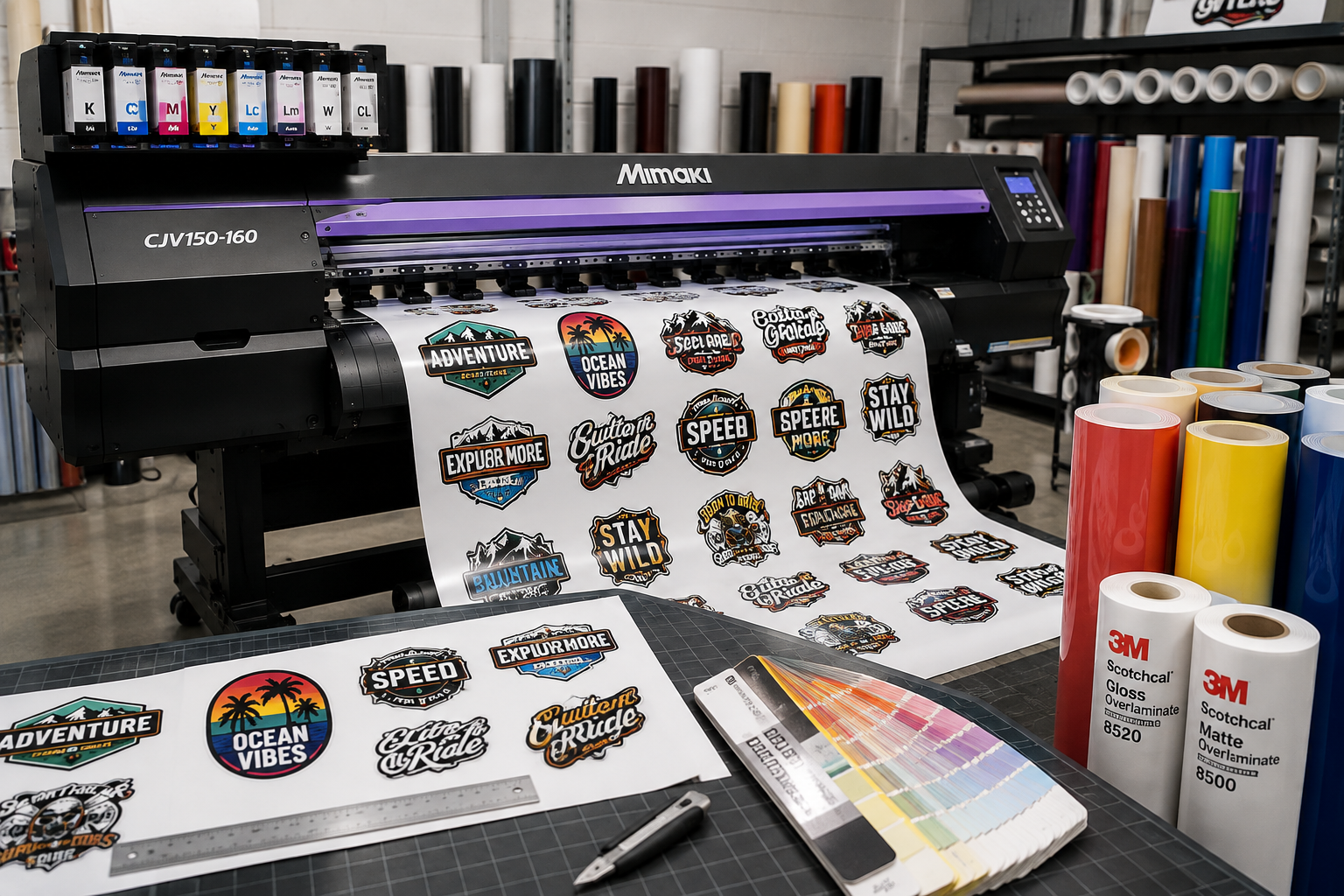
Sign businesses most often land on the Roland vs Mimaki printer comparison when researching equipment, and for good reason. Both are well-suited to different production environments. The decision is not about which brand is better overall. It is about which one fits the specific workflow.
1. Roland DG
Suits small to medium sign businesses running varied jobs across a standard production day.
- Integrated print and cut in a single system reduces handling steps between print and finishing.
- Operator workflow is accessible without extensive technical background.
- Consistent colour output across general sign and decal work.
- Strong choice where production variety matters more than raw throughput speed.
2. Mimaki
Suits higher-volume production environments where throughput and media range are the primary requirements.
- Broad media compatibility across demanding substrates.
- Strong colour accuracy at production speed.
- Better suited to operations running high daily volume on a narrower job range.
3. Epson
Suits businesses where image quality and fine detail are central to the output.
- Exceptional resolution across photographic and detailed graphics.
- Colour consistency across repeat runs is a clear strength.
- Best applied where print quality is the primary client expectation.
4. HP Latex
Suits retail, interior, and display graphics environments.
- Output is dry on exit, which speeds up the finishing workflow.
- Low odour makes it practical in workplaces with limited ventilation.
- Efficient production workflow where turnaround pace matters alongside output quality.
|
Brand |
Production Environment |
Primary Strength |
|---|---|---|
|
Roland DG |
Small to medium sign businesses |
Integrated print and cut, consistent colour, operator accessibility |
|
Mimaki |
High production environments |
Throughput speed, media compatibility, colour accuracy |
|
Epson |
Photo quality and fine detail graphics |
Image resolution, colour consistency |
|
HP Latex |
Retail and interior graphics |
Fast curing, low odour, efficient workflow |
Media availability matters here too. The right printer for stickers is one that performs reliably with substrates stocked through local distributors. A machine requiring imported or specialised media with extended lead times introduces supply risk that affects production continuity.
Running Costs Outweigh Purchase Price Across the Equipment’s Life
Purchase price is a one-time variable. Operating costs accumulate across every production hour the machine runs.
Ink consumption rates, printhead lifespan, maintenance intervals, cleaning cycle media wastage, and power consumption during standby all contribute to the real cost per square metre.
For a business running consistent daily volume, that figure measured across three to five years frequently exceeds the original acquisition cost by a significant margin.
The Cost That Does Not Appear on Specification Sheets
Unplanned downtime carries a cost that ink consumption figures do not capture. A machine offline for a service call delays client deliveries, disrupts scheduling, and creates labour costs when jobs are rescheduled around equipment availability. For businesses managing concurrent deadlines, that impact compounds across a production week quickly.
This is why supplier selection matters as much as equipment selection. A printer for vinyl signs supported by a supplier with genuine spare parts in local distribution, specified maintenance response times, and operator training produces a lower total cost of ownership than the same machine bought from a supplier without that infrastructure.
Assessing Total Cost of Ownership
When evaluating any shortlisted printer, the following factors determine real operating cost:
- Printhead replacement cost under typical duty cycles.
- Software licensing and workflow integration requirements.
- Cleaning cycle frequency and media wastage generated per cycle.
- Ink consumption rates and cartridge pricing across standard production runs.
- Supplier maintenance programme availability and response time commitments.
Matching Equipment to Business Size and Production Stage
Equipment should reflect both current production demand and realistic growth across a three to five year horizon. Buying ahead of workload creates capital tied up in idle capacity. Buying short of workload creates a ceiling the business hits faster than expected.
Sizing the Investment to the Operation
1. Start-Up Sign Businesses
Varied short-run work suits entry-level eco solvent print and cut systems. The integrated cutting functionality removes the need for a separate finishing device at the early stage, which keeps the initial investment and workspace footprint manageable.
2. Growing Print Shops
Higher volumes across a wider media range suit mid-production printers with larger media capacity and higher duty cycle ratings. At this stage, throughput consistency and media flexibility matter more than the entry-level price point.
3. High-Volume Commercial Operations
Continuous production suits industrial wide format systems rated for sustained output. Printhead durability, ink system efficiency, and uptime reliability become the primary selection criteria at this scale.
4. Specialty Graphics Businesses
Specific substrate or application requirements need equipment selected around those requirements rather than a standard production category. A wide format sticker printer configured for specialty materials often delivers stronger return on investment than a general production machine applied to the same work.
Conclusion
An ideal printer for stickers is the one that matches actual production requirements, not the one with the longest feature list or the most competitive initial price. Technology, media compatibility, running costs, workflow integration, and supplier support each carry weight in that decision.
Bi-Wize works with sign and print businesses across Australia to identify equipment that fits current production needs, available workspace, and realistic growth paths. The right equipment decision starts with understanding the workflow it needs to support. If you are planning an equipment investment, speak with the team before committing to a specification.
FAQs
What is the difference between eco solvent and latex for sticker printing?
Eco solvent suits outdoor applications and broad media compatibility, particularly for vehicle graphics and exterior decals. Latex suits indoor environments where fast drying and low odour are priorities. The right choice depends on the application environment for finished output, not print quality alone.
What running costs should I factor into a wide format printer purchase?
Ink consumption, printhead replacement, cleaning cycle media wastage, routine maintenance intervals, and power consumption across standby and active production. Over a three to five year operational life, these figures frequently exceed the original purchase price.
Does a vinyl decal printer need separate cutting equipment?
Not always. Integrated print and cut systems handle both functions in a single workflow, which suits businesses running varied short-run work. Dedicated cutting plotters suit higher-volume operations where separating the two processes improves overall throughput.
What should I look for in a supplier when buying print equipment?
Local spare parts availability, operator training, preventive maintenance programmes, genuine manufacturer consumables through Australian distribution, and technical support with specified response times. Equipment performs to its rated specification when the support infrastructure behind it is in place.